19 January 2011

Poop Apocalypse - The importance of thinking bio energy plans through

I’ve mentioned before that meeting a future oil crisis with hurt like a *****. But how can we prevent it, and what are the draw backs of those solutions?

In Denmark, we look fear in the eye, and underestimate it. So when we saw that the North Sea oil was running out, we established a climate commission that would work out how Denmark would become fossil fuel independent by 2050. The short version of the report can be found here, in english. I was fortunate to attend a lecture by one of the 8 people on the committee. Even more fortunate to receive one of his two hard copies of the climate report –I’m just that kind of gal. But back to the point. It is, according to the climate commission’s report, more than possible that Denmark become fossil fuel independent by the year 2050. And there was much rejoicing. However! There are circumstances. Most of the report promotes bio fuels, as the least expensive way to achieve this goal. In short bio fuels are extracted from either crops such as sugar or corn, or from byproducts such as kitchen waste or animal waste. And yes, animal waste is feces and urine. This creates a bio mass, from which bio- ethanol, bio gas and other bio fuels can be extracted.
It is speculated, that if Denmark goes all in on Bio fuels, while the rest of Europe  stand by and watches, we will make a great profit on bio fuels, and will experience the wind turbine adventure part two. But if the rest of Europe follows, we will struggle to produce enough biomass to meet our own needs.

Problem a) The definition of the system.

In the above mentioned, the system only contains Denmark. If we assume that our surroundings won’t act as we do, we will make a huge profit. But can we afford to think like that? When planning for your country’s future supply security, you need to examine the situation holistically, from start to end. You can’t discard the rest of the world. I’m pretty sure they too would like heat, gas, electricity and something to run their cars on.

Problem b) The poop.

Bio fuel is great alternative to both fossil fuel and wind turbines, but we have to fully grasp their impact. Here an example. And yes, this really happened.

Some of my fellow students did a study on a biomass plant in Kenya, where the waste of a public toilet and bath house, was used to produce bio gas. It’s was a 2-for-1 deal. Give the community good toilet and bath facilities, and get an energy source out of it. Yes, human poop and pee is used to make gas. The students visited the plant to investigate and suggest improvements for the biogas facility. The plans for the facility were thought up almost 6 years go. Here’s the great part:

When the facility was planed, built and then 3 years ago taken to use, there was no plan, non what so ever, for how to dispose of the sludge. So in 2010 they had been operating for 3 years and now their tanks were full. No one had thought of what to do with the sludge once the tanks were filled. So now, when they needed to make some space in the tanks, they just kindof… well, emptied them in the Nairobi river. Yes, let that one sit for a bit.
They didn’t foresee the eventual capacity of the tanks. There was no long term plan, and now all the sludge, all that human waste, is going into the Nairobi River. I wonder what else goes into that river? I wonder how many people wash themselves in that river? How could this happen? Is it the illiterate 3rd world countries that are just too dumb to plan and operate such facilities? It must be, right? Guess again. This project is an 1st to 3rd world aid project, like so many others. What whent wrong here, was communication and logistics. It was simply somebody else’s problem.
                                                                                  
Problem c) The resources
         
You might be thinking ‘Why use poop? Why not keep using crops?’
Remember the global food crisis a few years back, when prices on corn and flower sky rocketed, sending millions of people into starvation? One of the main reasons for that was the increased use of crops to produce bio fuel, which expanded the demand for corn and other crops that can be used for bio fuels, which made prices rise.
If you’ve got your pulse on the bio fuel beat you might be saying ‘Well, yes that was the 1st generation bio fuel. Then came the 2nd generation where byproducts from farming was used, and now the 3rd generation of bio fuels, where algae is used instead of crops, is showing great potential’.
I say, right you are. Algae holds a far greater potential energy that crops, without making food prices soar. However. You still need to produce a huge amount of algae if you’re gonna provide fuel for the entire world. The algae has to be farmed, and this takes up a lot of space. The barren desserts in the U.S. have been suggested for mega algae farming facilities, which might look something like this.


(Image by John MacNiell via inhabitat.com)

But it’s in no way enough to meet energy demands, even if you place such farms in all barren, but accessible, regions of the world. 


Growing up we have all been told, that we should not put all our eggs in one basked. The future energy supply is not an exception. Betting on only one source of energy to sustain the energy need for tomorrow, whether it be wind power, bio fuels, nuclear power or crude oil, will cause more problems than solutions. Holistic thinking, where more than just the nearby system is uncluded, as well as viewing the full life cycle of your energy source including resource availability and disposal of byproducts, is essential for securing energy and other resources. This along with global awareness, combined solutions and good communication will keep us from smashing all our eggs, that we so far still carry in one basket.


Extra note on bio fuels, added January 22: On the 21nd the Los Angeles Times ran this article about how the EPA will now allow for up to 15% ethanol blended in gasoline for cars produced after 2001. This will on one hand shift the power balance a tiny bit, from a crude oil dependent future, to a more sustainable economy, and better yet, en a smooth transition. But it is still important to not view bio fuels as the only way to a renewable energy source. Replacing one addiction with another is not a cure. 

1 December 2010

When the last hotdog stand is gone.

In October 2009, the Danish newspaper Politiken publish an article about the fact, that now there were more Sushi restaurants than hotdog stands in my home city, Copenhagen. The entire article can be found here (in Danish).

I think the declining number of hotdog stands can have a severe impact on the communicative interactions, in the everyday life of Copenhagen citizens.

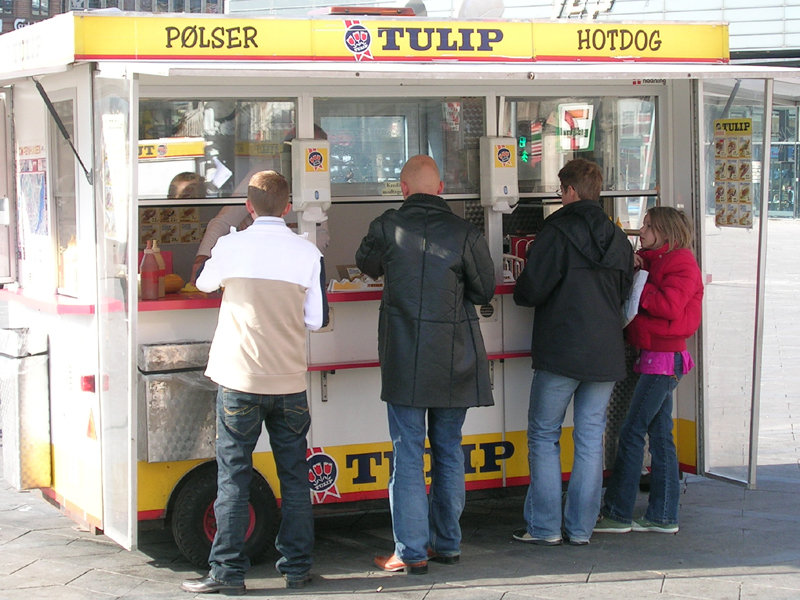
Now, I’m gonna have to give you an introduction to the concept of a Danish hotdog stand. I shall gladly admit that I haven’t traveled a lot, but from what I’ve seen, the Danish hotdog stand is like no other hotdog stand in the world. Why is this? Well, being a nation that has a production of five pigs pr. capita, Denmark has a long standing tradition of eating pork, and pork related foods. We do love us some bacon. Even better, we love to rap the Bacon around some other form of pork, like a sausage. This is in Danish hotdog slang called a ‘red Henning in tarpaulin’, Henning being a male name. If you think that’s wierd, well, we call a plain hotdog an ‘Indian with a side carriage’.  Yes, we have quite the hotdog culture here. Last year, an organic hotdog stand even won the award for being the ‘Best place to eat in Copenhagen’.   
But back to the standard hotdog stand. This is what I looks like.


Now see, the interesting part that I want to get to, is the culture of talking with the vender, because in Denmark, the hotdog vender does more that sell you hotdogs. He talks with you. He listens to you. He serves as a kind of bartender. It’s custom to chit chat with the vender and if there’s no rush, to start a conversation with the sausage flipping man. But this is about to end. The hotdog stands are fading out of Copenhagen, and are replaced with healthier, tastier foods. I don’t think this is a bad thing, but I do wonder about the conversations with the vender and the sociological effect of they’re absence. Casual chit chat is a part of cultural norm, as well a fulfillment of a personal need. It’s a way of taking the edge of the emotions of everyday life. And the vender doesn’t mind that you nag a bit about your boss, or wife or the alarm not going off this morning. As long as you do it with a slight smile on your face, he will nod understandingly and tell you, “aint that the truth”. You unload a bit and can now face the rest of the day, in a slightly better mood.

Every culture has this interaction, this reassurance that, yes life can be annoying sometimes, and it’s ok to think so. But the providers of this comfort are getting more and more scattered. With the increased use of social media like facebook and twitter (and the decline of hotdog stands) our unloading patterns have shifted. We still nag about the weather and the alarm clock, those universal subjects of annoyance, but the rest has gotten an anonymous distant feel to it. We don’t log onto facebook to be reinforced that wives are demanding or husbands are hopeless. Of cause we’ve all seen the examples of “my boss is an ass and now I’m pretending to be sick” posts, were the nagger forgot that he/she had added their boss as a friend. Woops. But, now we’ve learned to navigate in social media, and that carries along with it a silence.

Now we’re searching for a new hotdog vender. An anonymous place to unload and be told, that it’s ok to feel like this. One of the effects of the expanding social networks, is that we fragment our network to a greater degree. There’s one friend for that problem and one friend for this problem, ect. But that’s an awful lot of emotional strings to keep track of, in comparison to telling a stranger that your day sucked."Did I tell Margaret about my boss not being capable of hosting meetings, or was it Dylan?" Somewhere the tension had to be lifted, but where did the information go, and how will it affect you and the friend you unloaded onto?
So what will happen? Well, I see two possible outcomes: 

  1.  We adapt in a way where we learn to handle our emotions better, where we learn to realize and trust that ‘yes, it’s ok to find the boss and spouse as annoying as the alarm clock’, but worrying and nagging about it, is just a expression of our own frustration and insecurity, and therefore a total waste of time, or
  2.  That the need for social approval is so deeply rooted in us that we will have to either find a new source of reinsurance, and use friends and family to mirror us in -“Is this normal? Is your boss also stupid?”- or to bottle it up inside until we finally end up telling our boss to go [censured] himself.


I’m rooting for 1, but unfortunately I think we are slaves to our need of social approval to such a degree, that we would rather extreme fragment our social relations and try to keep the stories straight, than trust that we are normal and that our frustrations are both ok, temporary and not really that important in the scheme of things. After all, every alarm clock fails at some point.   

24 November 2010

Sustainability, stupidity and socks.

The following is about some of the basic problems in changing lanes to a more sustainable future, and about sustainability cognition:

This post sprung out of something as simple as a journey from my bedroom to the bathroom. I went to go use the bathroom, but had to turn back to put on a hoodie and knitted socks because it was so freaking cold I couldn’t stand it. Now, I far from live in a mansion. In fact, there’s only about 1,5 meters from my door to the bathroom. So why the desperate need for warmer clothing? Well, we’re on the top floor. Right above us, is the attic. This is what it looks like:


Do you see it? The bare bricks, the total lack of insulation?

And this is the view from my window. The white stuff is snow (Sorry for the newb like window reflection, but there was no way in hell I was opening that window).


In other words, I live in a country that has a chance of snow from November to April, but has very low standard requirements for insulation, regarding buildings build before 1980. And that combination makes me a little bit angry. Cold and angry. And this is not a raggedy old building, this is a standard building I Copenhagen.
The following picture is from one of the cities in Denmark the closest to Copenhagen, in terms of size, culture and age of buildings. It’s taken with a 45 degree angle, so that it is possible to see the facades, as well as the roof tops. Lots of heat just getting lost. Lots of energy just wasting away.


Studies show that more than 20% of Denmark’s total energy consumption can be eliminated, just by isolation our current, badly insulated buildings (in Danish). Some even argue it’s closer to 35%. I would actually love to say that Denmark is one of the worst sinners in the world when it comes to bad insulation, but we’re not. We’re like most other countries in the world. Actually we’re in the good end of the scale. A terrifying thought.

There have been different initiatives from the government to promote investment in housing insulation, where citizens could apply for financial help, in order to put in new and better (or any, in my building’s case) insulation. But this was only to stimulate the economy in the financial crisis, and now that the economy is finding a balance again, isolating your house just isn’t as attractive as buying that new car.

So why is it that, even though the insulation would still be a better investment than the car, we don’t see people rush to the insulation companies? I’ll tell you. The insulation has no bling. No status. How are you gonna show of your wealth and style? With a 2,5 inc fiber filling, or with a new Ford?  Now, I don’t wanna go as far as saying that human beings are stupid as a whole, just a little bit tied to our biological and social need of being accepted by the pack, in order to ensure our survival. We are a pack animal and we need to fit in to remain in the pack, and to show of power to excel within the pack. Hence the new Ford.

So now we seem to have an issue. We have nice cars, but will soon have no gas to put in them, and we have a big energy bill, that will only get bigger as prices of fossil fuel will rise. That seems to me kind of, ummh.. Stupid. But on the other hand, you can’t just rise against the pack, keep the old out-of-fashion-car, and use the money on insulation, unless it was all of a sudden in fashion to plan for the future and save money. Unless all of the sudden you knew, that fossil fuel prices would only go up, and that you would have to cash out. The economic crisis had a wonderful effect on the world’s sustainability cognition. All of the sudden it became popular to invest in renewable resources. Just like it did in the past oil crisis’. We saw the point, we saw the necessity. And most importantly, we saw ourselves. We saw, and we knew that keeping passive, will hit us hard. I have a motto:
The biggest lie in sustainable management is that we are doing this for our children and our children’s children.
We’re not. We shouldn’t be. We should be doing it for ourselves. Renewable resource reserves such as crude oil and helium will have run out, before I even retire. Old age is gonna suck if we don’t act now. Unfortunately, the only thing that reminds us of this, is a crisis. When the world has settled again, we go for the car. So what do we do? Launch the world into a global crisis every now and then, just to stay on our toes. Insert a sense of panic every so often? NO! (I’ll get back to that in a later post) Fear is not the answer.

We have to change the way we interact and the themes for which we are accepted into the pack. What if your neighbors frowned at you for not insulation your house, for not buying energy efficient appliances, for not eating organic food, what would you do then? What would you do to fit in and be accepted? What if the community, if states, pushed its government to make decisions that were long lasting, economically beneficial, and would secure enough resources for its citizens? Where would it start?

I think it starts in the individual. In the stubbornness of one person, to do what he or she finds to be right. In standing up to the pack and not buying that car. Then it spreads. Friends, family, neighbors, facebook relations. At some point these norms reach the key people who have governance enough to make a substantial difference. It’s all about the first movers. Marketing science knows this. Communication science knows this.  It’s time for environmental science to know this. It’s time for environmental science to understand that if it wants to succeed, if we want to succeed, we need to draw upon knowledge from other scientific branches, such as communication, economics, social network science, behavioral science, learning theories and much more.

I believe it’s doable. I also think I will be posting a lot more about the dilemmas and promises of this approach. In the mean time, maybe I should learn how to knit, so I’ll have socks for my freezing home.


18 November 2010

Is Google the new Hippie?

I was thinking earlier this month, that hippies need to get in the game, and realize that you can’t prevent climate change by making people ride bikes. I was thinking this after yet another encounter with a stubborn professor who thinks that electric cars and bio fuels, are a part of the problem, not the solution. Yes, our habits regarding the use of cars needs to be improved a lot, but replacing the SUV with a steel horse isn’t the answer. And then I found this article: Google Invests in Shweeb’s Pedal-Powered Bike Monorail. Yes, $ 1.05milion dollars are going into ‘research and development to build a showcase transit system in the northern hemispher’.

Now, being an eco geek, a resident of Copenhagen and a bicycle lover, you might think that I would like this idea. If you knew about my hatred for most kinds of public transportation, you might even think that I would love it. But honestly, I think it’s stupid. A friend of mine commented that she liked it, it would keep her dry. I resent biking in the rain as much as the next person, but I don’t think a pedal powered mono-capsule is going to be a thing. You still have very limited mobility. You can’t just decide to get off, you can’t use it for transporting goods ie. when shopping, and worst of all: You can’t just cut of the slow person in front of you. It’s like public transportation in a bubble, were you can’t transport stuff, and you’re doing all the work yourself. And then there’s the infrastructure. Monorails don’t build or maintain themselves, and they require lot of materials, which of course come from natural recourses, such as oil.

But this isn’t about the monorail. It’s about the strange change we see in the way international corporations engage in the public discourse, and actively try to influence it in the direction of a more sustainable world. Google has a partnership with the United Nations Environmental Programme, UNEP. Bil Gates donated $700.000 to preserve the California Global Warming Solutions Act, that aims to fight climate change and lower California’s air pollution and Pepsico has developed a web based crop management tool called i-crop to 'help farmers accurately calculate water use and carbon emissions’.


These are all examples of businesses, who don’t directly gain from investing in sustainability or public information, but do it anyway. How come the big businesses are taking the lead as our green salvation? Is it the demand of the consumer that ‘something must be done’? Or is it simply in fashion for big businesses to have a green conscience? And shouldn’t governments be paying attention to this trend? Why isn't the state the driving force in securing a future for its citizens, in aiming for a fosil fuel independent economy and in cutting CO2 emissions?

Maybe I asked the wrong question I my header. Maybe it should have read: Is Google the new state?